
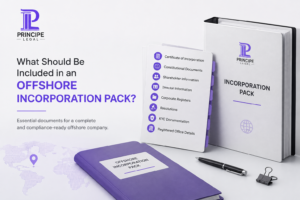
Setting up an offshore company involves more than registering a business name and receiving a certificate of incorporation. A properly prepared offshore incorporation pack brings together the essential corporate documents needed to establish the company, demonstrate its ownership structure, and support its ongoing administration.
For businesses operating across international markets, having a complete and organized documentation package can make corporate onboarding, banking introductions, licensing applications, and future corporate changes easier to manage.
The exact documents required vary by jurisdiction and company type, but a well-structured offshore company incorporation pack generally contains several core categories of documentation.
What Is an Offshore Incorporation Pack?
An offshore incorporation pack is a collection of documents prepared when establishing an offshore company. It provides a formal record of the company’s creation, ownership, management structure, and constitutional framework.
Depending on the jurisdiction and structure, the pack may include incorporation certificates, constitutional documents, registers, resolutions, director and shareholder information, and other supporting records.
The objective is not simply to create a large collection of documents. The documents should be accurate, consistent, clearly organized, and suitable for future corporate administration.
1. Certificate of Incorporation
The Certificate of Incorporation is one of the fundamental documents in an offshore incorporation pack. It serves as formal evidence that the company has been incorporated under the relevant corporate framework.
It generally contains information such as the company’s legal name and incorporation details.
Businesses may need this document when dealing with banks, payment providers, professional advisers, counterparties, or other institutions that require evidence of corporate existence.
2. Constitutional or Corporate Documents
An offshore company will typically have constitutional documents establishing how the company is structured and governed.
Depending on the jurisdiction, these may include articles of association, memorandum documents, or equivalent corporate instruments.
These documents can establish important matters such as:
- The company’s corporate structure
- Share capital and ownership provisions
- Rights and responsibilities of shareholders
- Governance procedures
- Rules concerning directors
- Procedures for corporate decisions
Keeping these documents properly organized is an important part of maintaining a reliable corporate record.
3. Shareholder and Beneficial Ownership Information
A complete offshore incorporation pack should clearly document the company’s ownership structure.
Relevant information may include shareholder details, shareholdings, beneficial ownership information, and other records required under the applicable corporate framework.
Accurate ownership records are particularly important when the company later undergoes banking, licensing, compliance, or due diligence reviews.
The information should remain consistent across corporate registers, identification documents, applications, and other supporting records.
4. Director and Officer Information
Details concerning the company’s directors and other relevant officers should also form part of its corporate records.
This can include information about appointed directors, their roles, and supporting identification or corporate documentation where required.
When directors change in the future, the corporate records should be updated accordingly. Maintaining accurate director information helps ensure that the company documentation remains current throughout its lifecycle.
5. Corporate Registers
Corporate registers are another important component of offshore company documentation.
Depending on the jurisdiction and company structure, registers may record information relating to shareholders, directors, beneficial owners, and other corporate matters.
These records provide an ongoing history of the company’s structure rather than simply documenting its initial formation.
For this reason, offshore corporate records should be maintained after incorporation and updated when relevant changes occur.
6. Initial Corporate Resolutions
Initial resolutions can document important decisions made when establishing the company.
For example, the company’s directors or shareholders may need to approve matters relating to the company’s administration, appointments, banking arrangements, or other organizational decisions.
Properly drafted resolutions create a clear documentary trail and can become useful references when the company undergoes future corporate actions.
7. Registered Office and Agent Information
An offshore company may also require a registered office and registered agent or equivalent corporate administration arrangements, depending on the jurisdiction.
The incorporation documentation should clearly reflect the relevant registered information.
The registered agent can also play an ongoing role in receiving official correspondence, maintaining required records, and supporting administrative continuity.
8. KYC and Supporting Documentation
KYC documentation for offshore company formation is another important part of the onboarding process.
Depending on the structure and jurisdiction, supporting documents may include identification documents, proof of address, information about beneficial owners, and details concerning the company’s intended business activities.
KYC documentation helps establish who is behind the company and provides information needed for corporate onboarding and due diligence.
Businesses should ensure that supporting documents are current and that information is consistent throughout the incorporation file.
9. Business Activity and Structure Information
An incorporation pack should also reflect the company’s intended purpose and structure.
Information about the business model, activities, ownership arrangements, and intended markets can help ensure that the corporate structure is properly aligned with the company’s objectives.
This becomes particularly relevant when the company later seeks banking services, payment solutions, regulatory licensing, or commercial relationships.
Why Documentation Quality Matters
The quality of an offshore incorporation document pack can affect how easily a company manages its future administrative requirements.
Incomplete or inconsistent documentation may create additional questions when the company undergoes due diligence or makes corporate changes.
For example, differences in company names, shareholder information, addresses, or director details across documents can create unnecessary administrative work.
A structured pack with named files, clear checklists, and organized records provides a stronger foundation for future updates.
What Happens After Incorporation?
An offshore incorporation pack should not be treated as a one-time document collection.
Companies may later need to process:
- Director or shareholder changes
- Amendments to corporate documents
- Annual renewals
- Good standing certificates
- Corporate resolutions
- Share transfers
- Certified or legalized documents
- Updates to corporate registers
This means that corporate documentation should be maintained throughout the company’s lifecycle.
How Principe Legal Supports Offshore Corporate Documentation
At Principe Legal, offshore incorporation and corporate administration are approached as structured documentation processes. The focus is on creating organized packs that can support incorporation, onboarding, corporate actions, certificates, and ongoing administration.
The process can include clear requirements, structured documentation, consistency checks, filing sets, and implementation notes so that businesses have a usable corporate record rather than a collection of disconnected documents.
Conclusion
A complete offshore incorporation pack typically goes beyond a certificate of incorporation. It can include constitutional documents, ownership information, director records, corporate registers, resolutions, registered office details, KYC documentation, and other supporting records required by the relevant jurisdiction.
The most important consideration is not simply having documents available, but ensuring that they are accurate, consistent, organized, and maintained over time.
For businesses establishing international structures, a professionally prepared incorporation pack can provide a strong documentary foundation for corporate administration, future changes, compliance requirements, and cross-border business activities.